CLUB LIKE IT · 2006–2017
History of CLUB LIKE IT
From 2006 to October 31, 2017, CLUB LIKE IT operated as a club and live space in Shibuya, Ikebukuro and Roppongi, Tokyo.
This page archives the locations, culture and experiments that grew out of those years.
A floor in the heart of Shibuya’s record district. A first Ikebukuro venue inspired by New York’s legendary “Paradise Garage”.
A second Ikebukuro Sports & DJ Bar combining club music with sports viewing.
And in Roppongi, a small lounge called “Lounge L” designed for winding down after the main floor – a place to enjoy the afterglow.
Across these spaces, the core idea was the same:
“Create a place where people can safely enjoy the music they truly love with people they feel comfortable around.”
If this page brings back memories for those who were there – or simply offers a glimpse into what the club once was – then it has done its job.
Shibuya – in the heart of the record district
The Shibuya venue sat in Udagawacho, right in the middle of the record stores – facing the old TOWER RECORDS, next to MANHATTAN RECORDS and above Manhattan HOUSE / QUINT REX / Cisco Records (as of 2006). It was literally surrounded by the pop culture of that era.
Concepts and experiments
At the tail end of the analog record golden age, CLUB LIKE IT tried to extend club culture into anime and otaku territory. It ran a non-smoking club (featured on NHK “Ohayō Nippon”) and daytime, non-alcoholic high-school events (featured on TV Asahi’s “Street Fighter”) – both unusual formats at the time.
There were also memorable nights such as “ZARD OFF”, a fan-organised memorial event held after the passing of ZARD’s vocalist Izumi Sakai, which later gained semi-official status. With venue rentals starting at 29,800 JPY, many niche events were born here before the role was passed on to the Ikebukuro venues.
Anime & game meets club culture
From the very beginning, Shibuya experiments included intentionally mixing anime and game elements into club events.
DJs played remixes of anime songs and game music, VJs incorporated game footage and character motifs into visuals, and
cosplay guests were welcomed as part of the floor.
At a time when “anime songs in a club” or “a club where game fans gather” were far from mainstream, CLUB LIKE IT was quietly exploring an early form of what would later be called an “ani-club” vibe, building a loose bridge between club culture and anime/game culture.
Featured on NHK “Ohayō Nippon” as a rare non-smoking club at the time.
Introduced on TV Asahi “Street Fighter” as a fully daytime, non-alcoholic event for high-school students.
A fan-driven memorial party for Izumi Sakai which later came to be treated as a semi-official event.
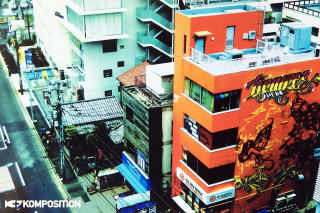
The building that hosted the Shibuya venue – surrounded by record shops such as Tower Records, Manhattan Records and Cisco Records. The location itself carried the full heat of the Shibuya music scene.
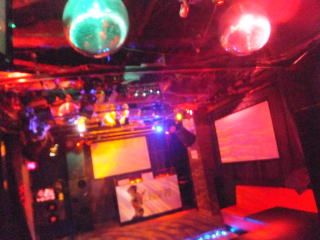
Part of the Ikebukuro floor: low ceilings, a close mirror ball and nearby screens – a dense, classic compact club layout.
Ikebukuro 1st – A nod to Paradise Garage
The first Ikebukuro venue was designed with New York’s “Paradise Garage” in mind – not as a copy, but as a small homage. It stood out visually and atmospherically, evoking the roots of club culture.
A wide range of events took place there, with DJs, staff and audience sharing a tight physical space. The venue carried the feeling of being “a place that takes music seriously”.
Ikebukuro 2nd “LIKE IT+K” – Sports & DJ Bar
“LIKE IT+K”, opened near the west exit, was a Sports & DJ Bar where club music and sports viewing coexisted. With free entrance and no table charge, it offered hip-hop and R&B alongside darts and live sports broadcasts.
As the “+K” hints, the kitchen played a major role as well, experimenting with izakaya-style food menus. The venue aimed to sit somewhere between “everyday life with music” and “a special event night”.
Roppongi “Lounge L”
The Roppongi venue, “Lounge L”, was a lounge bar located in one corner of the ever-changing Roppongi nightlife area.
It was designed as a place to enjoy the afterglow – a space to cool down after dancing on the main floor, with softer volume and lighting.
Surrounded by streets where different cultures and people intersected and where neon and city noise were always in the background, “Lounge L” existed as a spot with a calmer, steady rhythm. In contrast to the “movement” of the dance floor, it played the role of “stillness” – a cool-down lounge for those who wanted a quieter end to their night.
Archive & related links
Some of the sounds and atmosphere that once filled these rooms still live online in different forms.
We keep them as small doors you can open whenever you want to revisit “that feeling” for a moment.
Event footage (archive videos)
- Spotify A selection of tracks played at CLUB LIKE IT between 2006 and 2017/10/31 is curated on Spotify as an archive of the era’s floor music.
- CLUB Music >> Articles related to club music (Ameba Blog)
- Blog >> LIKE IT blog (Ameba Blog)
- YouTube dj_hiro / hiro_tv / likeit channel / t-room channel
- Instagram @likeit2006
Profile & Contact
The physical venues of CLUB LIKE IT are now closed, but the experience gained there lives on through likeit.tokyo and the likeit.biz group.
likeit.tokyo / Likeit Tokyo
Over 11 years, CLUB LIKE IT operated club / live / sports & DJ bar venues in Shibuya, Roppongi and Ikebukuro.
Today, within the LIKEIT Group, we handle
event production, F&B, PA / DJ, operational advice and subculture-related projects.
■ Inquiries (Mail)
info@likeit.tokyo
■ For urgent matters (Japan)
Office: 03-6459-0665 / Mobile: 070-6574-0145
Please mention “Likeit Tokyo / CLUB LIKE IT”.
dj_hiro(@dj_hiro) / dj_hiro Official YouTube Channel
Memories Gallery
Small fragments of CLUB LIKE IT – photos of the venues, floors and logos – collected as thumbnails.
In the future this section may grow to include more photos and links to Instagram posts.
Shibuya – the building in the middle of the record stores.
Ikebukuro – compact floor with low ceiling and mirror ball.